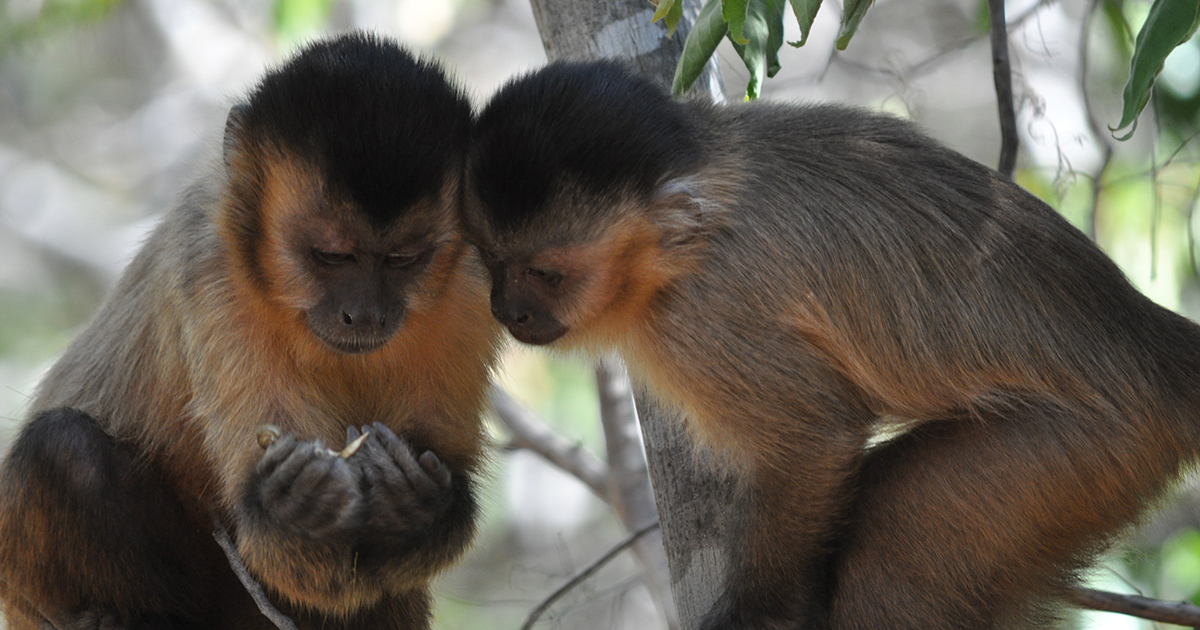
















Filhote de chimpanzé abraçado na barriga de um chimpanzé adulto que está de costas para a foto.

Facial touch contributes to the social development of human and chimpanzee infants

In both primate groups, baby touching was associated with shared caregiving and moments of joint attention

 31/03/2025 - Publicado há 11 meses

Text: Fernanda Zibordi*
Art: Diego Facundini**

Leia este conteúdo em PortuguêsBefore humans develop speech, they are already able to communicate through sounds, expressions, and gestures. Babies, who are taking their first steps in social interactions, use their bodies to interact and engage with the world around them, and touch is among the most common actions in this context. This is why an article published in the scientific journal Animal Cognition sought to document the touches of human and chimpanzee babies on the faces of other individuals. The study observed different groups to verify the importance of social touch in the development of primate offspring.

Social touch can be defined as any behavior of physical contact between at least two beings that involves some engagement. “Hugs, hand-holding, and affection are all social touches, which are not always positive,” says Beatriz Felicio, one of the authors of the article. Touches are subject to subjectivity, as their interpretation and meaning can vary depending on the situation.

Beatriz Felicio, a PhD student in Experimental Psychology at USP’s Institute of Psychology (IP), focused her master’s degree on the importance of facial touches in populations of capuchin monkeys. Because of the small number of studies on the subject, the researcher decided to delve deeper into it and extend the investigation to humans and chimpanzees. The research, funded by the São Paulo State Research Foundation (Fapesp), was to see if social touch was already important for infants of possible common ancestors between the capuchin monkey and hominids.

Mulher adulta de cabelos curtos e escuros e olhos escuros. Veste uma camisa azul.

Beatriz Felicio - Photo: Personal Archive

Social ecologies

To observe the behavior of human and chimpanzee babies, Kim A. Bard, a researcher at the University of Michigan and co-author of the article, had access to records of different development environments, also called social ecologies. 

The group of chimpanzees targeted babies approximately one year old. It consisted of animals from a zoo in the United Kingdom, a sanctuary in Japan, and Gombe National Park – a reserve with free-living chimpanzees in Tanzania. Records were selected from communities in England, Cameroon, and the Central African Republic for the human group. 

Beatriz emphasizes the study’s importance to this ecological and cultural richness, arguing that psychological research done only with people from the same countries and customs can acquire strong biases. “When you only use one human sample group, it is very difficult to say that this is certainly true for humanity. You cannot say that. So it really was a great opportunity to do some interesting research.”

Mulher adulta de cabelos claros e na altura dos ombros. Veste uma blusa cinza, usa óculos e está com uma das mãos apoiada no queixo.

Kim A. Bard - Photo: Personal Archive

Mãe e bebê chimpanzés sentados na grama um de frente para o outro.

Similar to humans, chimpanzees develop strong social bonds throughout their lives - Photo: Guerrero De la Luz/Pexels

After 36 hours of observation, 269 touch events were recorded, of which 222 were facial touches and 47 were head touches. Despite the differences between the groups, some common results caught the researchers’ attention. Beatriz cites as one of the most important the conclusion that face touching in these species is affiliative, always associated with positive or neutral contexts, such as playing and sharing food.

"Joint attention events mean you have two individuals keeping their attention on a third thing, it could be an activity, an object. (...) We tested whether face touching happened when there was an engagement of this kind, and it's basically always."

These touches, also described as pro-social events, were associated with babies’ preference for interactions with adult females, usually their mothers. The researcher draws attention to this result, as previous studies with capuchin monkeys did not observe it.

Small and social

“It is very common to think of infants as beings who only receive: you interact with the baby, not so much that the baby goes after your interaction. We do not see them as modulators of social networks,” says Beatriz. For her, the research results show how, in reality, these individuals are able to initiate interactions and share events with others from a very young age, already engaging in their first social relationships through touch. 

The scope of the study, both for humans and chimpanzees, contributes to the investigation of a behavior that is still little explored but important for the development of primates’ social lives. “It also impacts comparative psychology, which is when we try to compare human beings with other species and see where we stand,” concludes Beatriz.

The article Great ape infants’ face touching and its role in social engagement can be read here.

More information: beatrizffs@yahoo.com, with Beatriz Felicio.

English version: Nexus Traduções

*Intern under the supervision of Fabiana Mariz
**Intern under the supervision of Moisés Dorado


Política de uso 
A reprodução de matérias e fotografias é livre mediante a citação do Jornal da USP e do autor. No caso dos arquivos de áudio, deverão constar dos créditos a Rádio USP e, em sendo explicitados, os autores. Para uso de arquivos de vídeo, esses créditos deverão mencionar a TV USP e, caso estejam explicitados, os autores. Fotos devem ser creditadas como USP Imagens e o nome do fotógrafo.