


















Nanodisks: new ultrasensitive sensor detects identical molecules with opposite effects

Sensor employs materials that emit magnetic fields to detect chiral molecules with similar compositions but different structures and biological behaviors

 Publicado: 06/03/2026 às 9:45

By: Júlio Bernardes
Art by: Gustavo Radaelli*

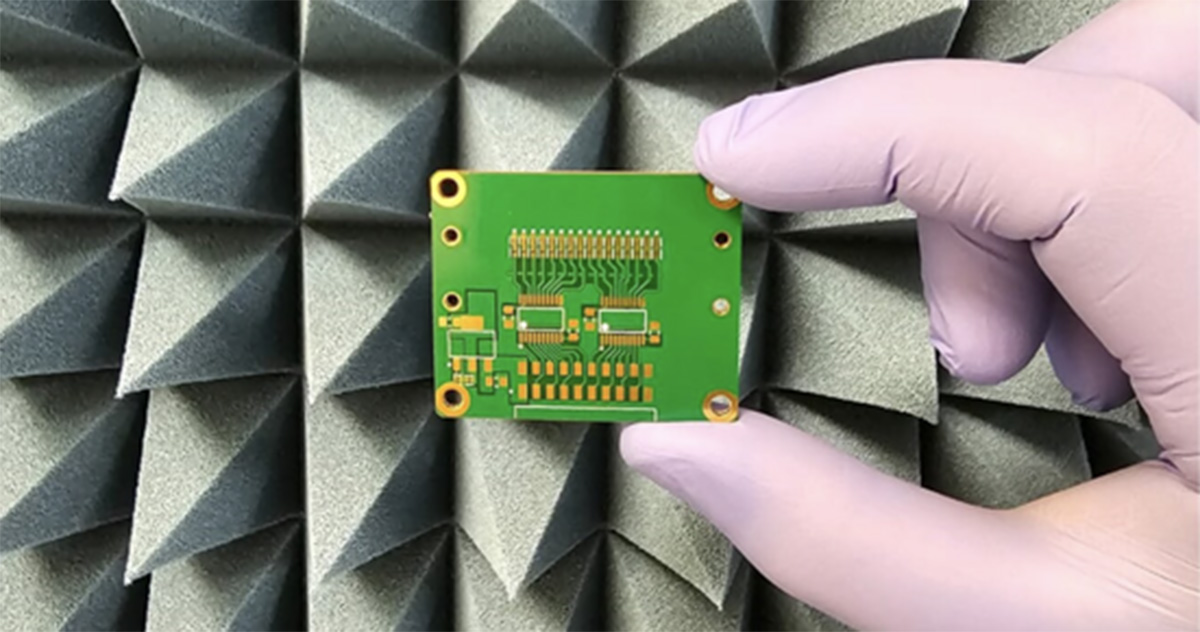
Em frente a uma superfície pontiaguda cinza, mão com luva de cor violeta segura uma placa de circuito impresso usada em dispositivos eletrônicos

System may be used in early diagnosis through the detection of biomolecules at extremely low concentrations, analysis and quality control of pharmaceuticals, and real-time monitoring of biological processes without fluorescent labels – Photo: IFSC

In nature, there are molecules that, despite sharing the same composition, behave in opposite ways because they are mirror images of one another — the so-called chiral molecules. To facilitate their differentiation, researchers from USP’s São Carlos Institute of Physics (IFSC) and the National Institute of Telecommunications (Inatel) in Brazil developed an ultrasensitive sensor capable of identifying these structures at minimal concentrations or even as isolated molecules.

The device consists of nanodisks that have the property of confining and amplifying electromagnetic fields, enabling molecule detection through the optical response they produce when in proximity to the disks. In practice, the sensor “sees” the molecule through its optical response, revealed by interaction with light. The nanodisks made of alternating layers of gold and a magneto-optical material create an electromagnetic field that “forces” the chiral molecule to reveal its spatial orientation much more intensely than ordinary light would.

Tested in computer simulations, the system may be used in biomolecule identification, pharmaceutical quality control, and real-time monitoring of biological processes. “Chiral molecules are those that cannot be superimposed on their mirror image, as occurs with the right and left hands”, said Osvaldo Novais de Oliveira Júnior, a professor at USP’s IFSC and one of the researchers who conducted the study, to Jornal da USP.

Homem calvo de óculos falando, com camisa social de listras verticais azuis, tendo ao fundo a foto de uma rua colocada numa parede vermelha

Osvaldo Novais de Oliveira Júnior – Photo: IFSC

“This property is common in molecules fundamental to life, such as amino acids, proteins, carbohydrates, and lipids, and it also appears in many medications”.

Natural Optical Signals

“Chirality is important because two molecules with the same composition, but opposite chiralities, called enantiomers, may have different biological behaviors”, the professor explains. “This influences biochemical interactions and responses to drugs in the human body. In biomolecules, changes in chirality and structure are also discussed in the literature as relevant in the context of neurodegenerative diseases”.

According to Oliveira Júnior, the main difficulty in detecting chiral molecules is that their natural optical signals tend to be very weak. “Since molecules are much smaller than the wavelength of light, the response measured by conventional techniques usually requires high concentrations or large sample volumes”, he notes. “When attempting to detect few molecules, or even a single isolated one, these signals approach the detection limit. Therefore, more complex, costly strategies or those that use labels are required, which may hinder rapid and real-time measurements”.

“The objective of the work was to design an ultrasensitive magneto-optical metasurface for the detection of chiral molecules at extremely low concentrations, reaching the limit of a single molecule”, said William Orivaldo Faria Carvalho, a professor at Inatel in Brazil. “The proposal explores nanodisks formed by a magneto-optical hyperbolic metamaterial, capable of confining and intensifying electromagnetic fields, thereby enabling a measurable optical response even when the number of molecules is minimal”.

Ultrasensitive Surface

Metasurfaces are ultrathin structures designed to control electromagnetic waves with high precision. “They are formed by specific combinations of metallic and dielectric materials [which do not conduct current], exhibiting electromagnetic characteristics not found in nature”, said Oliveira Júnior.

“In our research, the metasurface features a periodic arrangement of nanodisks made of alternating layers of gold [suitable for confining light at the nanometric scale], a metal, and cerium-substituted yttrium iron garnet, a ferrimagnetic magneto-optical material, on a silica substrate”, Carvalho added. Cerium-substituted yttrium iron garnet is a material that reacts strongly to magnetic fields, enabling active control of light. “This combination forms a metamaterial with strongly confined and intensified electromagnetic fields within the volume of the nanodisks, extremely sensitive to changes in the immediate surroundings”.

According to Carvalho, in chiral detection, the metasurface is illuminated with right- and left-circularly polarized light, and a magnetic field is applied. “The system begins to reflect differently to the two polarizations, generating a measurable signal called magnetic circular dichroism (MCD),” he said. “The presence of chiral molecules in the vicinity of the metasurface modifies this response, both in wavelength shifts and especially in the amplitude of the MCD, which makes it possible to identify and quantify the chiral effect even at very low concentrations”.

em um sólido quadrangular azul, representando o substrato de sílica da metassuperfície onde estão distribuídos pilhas de círculos alternados verdes, da granada de ítrio e ferro substituído e cério, e amarelo, do outro, representando os nanodiscos

The combination of gold nanodisks, suitable for confining light at the nanometric scale, and cerium-substituted yttrium iron garnet, which reacts strongly to magnetic fields and enables active light control, on a silica substrate, forms a nanomaterial with strongly confined electromagnetic fields, extremely sensitive to changes in its surroundings – Image: IFSC

Real-Time Monitoring

“In this work, the system was investigated theoretically through numerical simulations, that is, it has not yet been presented as an experimental prototype of the optical sensor. Even so, the simulated results indicate very high performance, with significantly amplified signals compared to conventional approaches”, highlighted Jorge Ricardo Mejía-Salazar, a professor at Inatel in Brazil. According to Mejía-Salazar, the numerically validated strategy is compatible with nanofabrication techniques employed in the literature. “This suggests that the experimental realization of the proposed structure is feasible, and opens prospects for the predicted performance to also be experimentally validated”.

The most direct applications of the device are in ultrasensitive (label-free) chiral biosensing — a scenario in which nanotechnology meets precision medicine and pharmacology. The advantage is the ability to detect the “pure” molecule, since chemical labels may alter the natural behavior of the biomolecule or even destroy it. “More specifically, the system may be employed in early diagnosis through the detection of biomolecules at extremely low concentrations, analysis and quality control of chiral pharmaceuticals, and real-time monitoring of biological processes without fluorescent labels”, he said. “In addition, the capacity for active magnetic-field control and mastery over polarization and resonances may open pathways for new compact nanophotonic components and other applications in electromagnetic wave control”.

The research is described in the article Toward Optical Detection of Single Chiral Molecules Using Magneto-Optical Hyperbolic Metasurfaces, published in the scientific journal ACS Applied Materials & Interfaces. The study involved William Orivaldo Faria Carvalho, Jorge Ricardo Mejía-Salazar, and undergraduate student Ana Luísa Lyra Pavanelli, from Inatel in Minas Gerais, and Osvaldo Novais de Oliveira Júnior, from USP’s São Carlos Institute of Physics (IFSC).

More information: chu@ifsc.usp.br, with Osvaldo Novais de Oliveira Júnior

*Intern under the supervision of Simone Gomes 

English version: Nexus Traduções, edited by Denis Pacheco 


Política de uso 
A reprodução de matérias e fotografias é livre mediante a citação do Jornal da USP e do autor. No caso dos arquivos de áudio, deverão constar dos créditos a Rádio USP e, em sendo explicitados, os autores. Para uso de arquivos de vídeo, esses créditos deverão mencionar a TV USP e, caso estejam explicitados, os autores. Fotos devem ser creditadas como USP Imagens e o nome do fotógrafo.