





Blog
USP's Medical School in Ribeirão Preto introduces new curriculum aligned with international standards
The first class of the new curriculum has reached its fourth year, a stage that solidifies clinical training through an integrated model featuring structured mentoring, continuous assessment, and deeper integration into the healthcare system
Students in class at the Ribeirão Preto Medical School – Photo: FMRP
Medical education at USP’s Ribeirão Preto Medical School (FMRP) has undergone a structural reorganization that replaces the traditional fragmented discipline-based logic with an integrated, competency-oriented model. “We incorporated practices that have already been implemented as innovations in the Northern Hemisphere, in Europe, Canada, the United States, and Australia, adapted to the Brazilian context of learning oriented toward the needs of the Unified Health System (SUS)”, said Valdes Roberto Bollela, president of the Undergraduate Committee.
According to Bollela, the reform was driven by a review process initiated in the post-pandemic period, when USP launched a call to encourage the review and updating of curricula, and academic units were prompted to rethink their teaching and student assessment strategies.
In the new curriculum, training was reorganized into two major three-year cycles. The first, focused on the foundations of medicine, integrates content from basic and structural sciences: anatomy, histology, physiology, biochemistry, pathology, epidemiology, and scientific methodology, among others, which serve as the basis for the initial development of clinical and interpersonal skills, occurring simultaneously during this initial period.
The second cycle concentrates activities more related to professional practice and includes the transition to clerkship (4th year) and the clerkship itself (5th and 6th years), where, according to Bollela, “a progressive consolidation of student autonomy is expected, until they complete the course and are ready for medical practice safely and without supervision”.
The curricular change is not limited to structure. Alongside content integration, the program also includes five axes: 1. Humanism, Communication and Professionalism (HCP); 2. Scientific Thinking in Medicine (STM); 3. Community Health Care (CSA); 4. Programmatic Student Assessment (PSA), and 5. The formal axis of Personal and Professional Development (PPD), aimed at building the professional identity of future physicians, a dimension historically little systematized and often neglected in Brazilian medical education.
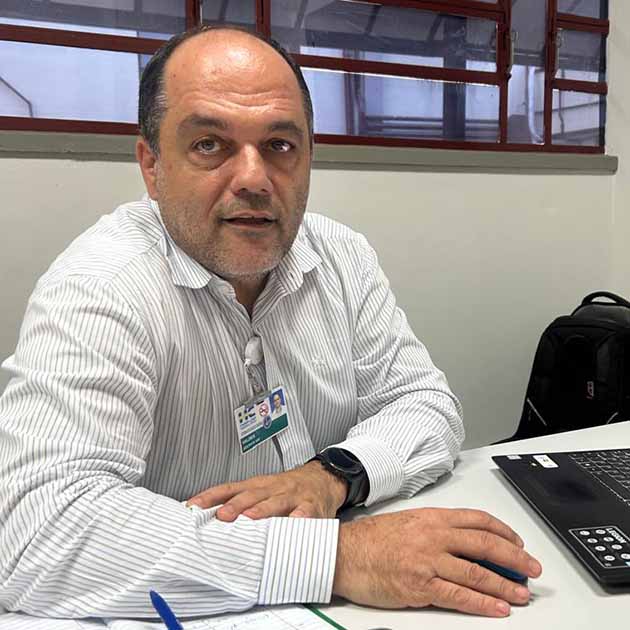
Valdes Roberto Bollela, president of the Undergraduate Committee at FMRP – Photo: Rose Talamone / SCS USP
The new curriculum began to be implemented in 2023, under the coordination of Júlio Moriguti, and at the beginning of 2026 reaches a decisive stage: the first class under this structure reaches the fourth year, when clinical training and professional identity formation become central.
For Moriguti, the main practical challenge of implementation was precisely the cultural shift within a well-established school. “As a very traditional school that trains excellent professionals, this change required stepping out of the comfort zone. There was a reduction in workload, the introduction of new teaching and learning methods, and modern longitudinal axes such as programmatic assessment, professionalism, and personal and professional development”, he said.
Bollela recalls that this progress occurs in alignment with the National Curriculum Guidelines (DCN) for medical programs, published in September 2025. “These guidelines reinforce competency-based training, organized around the SUS, socially responsible, and with innovations such as student assessment systems and the need to establish mentorship programs that support the development of the professional identity of future physicians”, he explained.
Real integration
According to Bollela, the reorganization of the curriculum responds to a persistent problem in medical education: the fragmentation of teaching. In the previous model, the program was structured around independent disciplines, often organized based on specialties, with a large volume of content and little articulation between areas. “You had a large set of disciplines, each pulling toward its own area. This made it difficult to understand and to develop essential skills for medical training and practice”, the professor said.
The new organization seeks to bring coherence to the educational pathway. Instead of a sequence of compartmentalized content, students now work with integrated themes and concrete health situations, mobilizing knowledge, skills, and attitudes in an articulated way, based on real practical experiences.
The change also redistributes the workload throughout the program. Still, according to Bollela, one of the critical points of the previous model was the fourth year, which concentrated a large theoretical workload and was the subject of constant complaints from students. “After previous curricular changes, the fourth year became overloaded, full of content, and students had little opportunity for practice”, he said. With the new design, theory and practice are distributed more evenly, allowing for more continuous learning progression and closer alignment with the reality of care.
However, Moriguti emphasizes that, throughout implementation, some adjustments were necessary. “There are always adjustments. We made specific changes to workload, included new topics and, especially in the clerkship, adaptations to expand the participation of different areas, such as internal medicine, imaging, oncology, and hematology. This required negotiation, but it did not alter the original project”, he stated.
Synthesis of the main elements of the new FMRP curriculum – Photo: FMRP
Human development
Class that entered in 2023, under the new curriculum, after a first aid class with the Ribeirão Preto Fire Department – Photo: Courtesy of Ribeirão Preto Fire Department
The reform also changes how students are followed throughout their undergraduate training. In the previous curriculum, aspects related to personal and professional development appeared in a dispersed manner or depended on occasional initiatives. “Students, especially in the early years of the program when classes are held in large groups, said that professors did not know them. That they did not know anything about them”, Bollela said.
The response was the creation of curricular mentoring programs in small groups, in which faculty members follow students throughout the course. These meetings take place within the personal and professional development axis and have protected time in the student’s weekly schedule, defined workload and faculty, with a ratio of one to two professors for each group of eight students. Mentoring meetings include discussions about lived experiences, practical situations, and challenges in training.
The proposal also creates an institutional space for issues that were previously part of the so-called hidden curriculum, that is, experiences and learning that occurred informally, without systematic follow-up and without opportunities for listening and reflection.
Among the teaching and learning strategies adopted in this axis are reflective narratives, in which students describe meaningful experiences and reflect on their learning. “If you don’t stop to think about what you have experienced, you do not learn from it”, the professor explained.
The proposal, according to Bollela, seeks to prepare professionals capable of dealing with clinical decisions, human relationships, and complex care situations, beyond technical mastery.
Continuous assessment
With the new curriculum, assessment has been completely reformulated and focuses on monitoring student development throughout the program, combining different assessment tools and frequent feedback. “Students cannot be evaluated only through exams. We need to look at skills, attitudes, how they relate to others and perform in practice”, Bollela said.
The change aims to overcome an assessment pattern centered on exams, in which students study for the test and not necessarily to consolidate the knowledge and skills required for the next stages of training.
Thus, in addition to evaluating performance, the new model takes on a formative function, allowing the identification of gaps, difficulties, and opportunities for improvement, as well as guiding learning throughout the process.
This new assessment model, according to Bollela, is based on a theoretical framework called Programmatic Student Assessment, which has existed for more than 20 years and was adopted in the new National Curriculum Guidelines (DCN) published last year. “In programmatic assessment, it is necessary to analyze and document results related to knowledge, skills, and attitudes. This process must combine formative moments, which promote learning, and summative moments, in which decisions are made (pass or fail)”, the professor explained.
Difference between assessment OF learning (which assigns grades and makes decisions) and assessment FOR learning (which supports learning and growth) – Photo: Courtesy of the researcher
In programmatic assessment, it is necessary for the school to establish an Assessment Committee which, together with faculty members, will monitor student progress and the acquisition of competencies. The results of student assessment will serve to review and improve the curriculum itself.
Images from e-Portfolio – Photo: Courtesy of the researcher
To support this longitudinal monitoring, the program has also developed its own digital platform, the student electronic portfolio (e-Portfolio). The tool was created within the context of a doctoral project by FMRP biomedical informatics specialist Luiz Ricardo Albano Santos, with results published in an article in the journal JMIR Medical Education in 2024. The system organizes, throughout the entire undergraduate program, records of student performance, bringing together assessment results, feedback, and evidence of learning in a single environment.
The tool also makes it possible to track each student’s individual trajectory longitudinally and to situate their performance in relation to the group, providing additional references to guide development throughout the program. “The idea is to follow the student over time, based on evidence of what they do and how they evolve”, Bollela explained.
Example of monitoring the student’s individual and longitudinal trajectory – Photo: FMRP
Technology
The reform also engages with recent transformations in medical practice, such as the use of digital technologies, artificial intelligence, telemedicine, and new forms of care organization, which now require greater flexibility and adaptability from professionals.
With approximately 600 undergraduate students, with an intake of 100 students per year, the program already has 400 students enrolled in the new curriculum, currently in the fourth year. The structure includes 64 mandatory courses at this stage and reorganizes the workload to ensure a better balance between theory and practice.
According to Moriguti, the coexistence between the old and the new curriculum has been organized effectively. “Everything was carefully planned to avoid overlapping students in the same learning settings. The coexistence has been quite appropriate, without compromising the quality of training in either structure”, he said.
Implementation is taking place ahead of the national deadline, which allows up to four years for all medical schools to adapt to the new guidelines published in 2025. The change is still ongoing and coexists with students trained under the previous model. Bollela notes that students from the unit who recently stood out in the National Examination for the Assessment of Medical Training (Enamed) had still been trained under the previous curricular structure. “Enamed is an exam that assesses knowledge and the application of knowledge in the medical context, and our expectation is that students from the new curriculum will perform as well as those from the previous curriculum, which was exceptional in the first edition of the exam in 2025”, he said.
Professors who form the core implementation group of the new curriculum – from left to right - Luiz Ernesto de Almeida Troncon; Felipe Villela Gomes, Jorge Elias Junior, Lucila Leico Kagohara Elias, Francisco Guimarães, Luiz Ricardo Albano, Maria Carolina de Oliveira Rodrigues and Julio Moriguti, in the foreground Valdes Roberto Bollela - Photo: Valdes Roberto Bollea/FMRP
According to Bollela, with the curricular change, FMRP expects to train more reflective physicians who maintain technical quality while developing greater ability to effectively relate to patients and their families, with the healthcare team, and with the healthcare system itself. The professor emphasizes that the changes were only made possible thanks to the active participation of students, both from the previous and the new curriculum, in building the proposal, as well as the engagement of the FMRP faculty, who, from the beginning, contributed with discussions, adjustments, and improvements to the original project.
Moriguti states that the collective construction of the curriculum, involving more than 100 faculty members, was also one of the critical aspects of the process. “Changing a medical curriculum is complex. We held numerous meetings with all departments, always with support from the administration. There was initial resistance, but it has been decreasing. Today, the perception is that the curriculum is working”, Moriguti said.
Moriguti and Bollela highlight the decisive role of the FMRP administration in conducting the process, from the tenure of Rui Ferriani and Jorge Elias Jr., who advanced the curricular change after approval by the Congregation, to the present moment, in which implementation continues under the leadership of Jorge Elias Jr. and Marisa Mussi-Pinhata.
For Bollela, this collective movement reinforces the dynamic character of medical education. “Those who work in education cannot assume that everything is finished. Knowledge changes, the context changes, the healthcare system changes. We need to keep up with that”, he concluded.
English version: Nexus Traduções, edited by Denis Pacheco
A reprodução de matérias e fotografias é livre mediante a citação do Jornal da USP e do autor. No caso dos arquivos de áudio, deverão constar dos créditos a Rádio USP e, em sendo explicitados, os autores. Para uso de arquivos de vídeo, esses créditos deverão mencionar a TV USP e, caso estejam explicitados, os autores. Fotos devem ser creditadas como USP Imagens e o nome do fotógrafo.