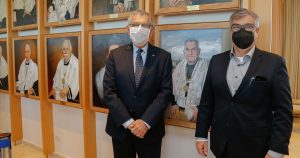



















 On March 10, the new U.S. consul general in São Paulo, Kevin Murakami, visited the University of São Paulo and was received by USP President Carlos Gilberto Carlotti Junior and the president of the USP International Office (Aucani), Aluisio Segurado.
“The United States has been a strategic partner of our university for many years, a partnership that is not limited to researchers and universities but also includes American companies and institutions”, said the president.
Leading the consulate since the end of last year, Murakami stated: “This is my first chance to visit the President’s Office and reinforce our support. We recognize the university’s prestige, and this partnership is very important to us. It is a relationship of decades, of generations, and we are here to learn more about USP, discover how we can help, and expand the collaboration”.
During the meeting, in addition to mentioning USP’s established partnerships with American universities and participation in programs such as Fulbright and the David Rockefeller Center for Latin American Studies, the leaders also discussed new opportunities. “American universities are USP’s main partners. Our intention is to further enhance this cooperation, increasing partnership opportunities in all areas and mobility among professors, researchers, and students”, emphasized Aucani’s president.
Also participating in the visit were the cultural affairs advisor, Wesley Oliveira, and the education and exchange advisor, Marcos Hirata.
Strategic partnership
Cultural attaché RaeJean Stokes noted that the consulate will soon have a space representing the United States at the USP International Intercultural Center. “We are very excited about this possibility. It will be a small space, but it will represent our presence at the university, a place to hold meetings and other activities. It will be a strong symbol of our partnership, especially this year as we celebrate the 250th anniversary of the United States’ independence”, emphasized Stokes.
The president pointed out that this could be a good opportunity to hold joint events to celebrate the date and defend values shared by both countries, such as freedom and democracy. Another point raised by the attaché was the level of English proficiency among undergraduate and graduate students, which has proven to be a challenge for Brazilian higher education. Regarding this aspect, Carlotti presented the English@USP project, which offers online English courses for undergraduate and graduate students at all levels.

An area of mutual interest is artificial intelligence (AI). Segurado commented that the university is structuring an office that will define the guidelines for the incorporation of AI into USP’s academic and administrative activities, with ethics and responsibility, making processes more efficient and regulating the correct use of these new technologies in academic routines.
“Incorporating AI into our various activities is a contemporary issue, and we intend to do this appropriately by guiding students, professors, and staff, and sharing best practices with other universities. We believe we can be a reference in this regard for other Brazilian universities and would be happy if we could find partnerships with American institutions”, said the president.
Regarding the research developed by the university in the field of AI, the president presented the Center for Artificial Intelligence and Machine Learning (CIAAM), which integrates various research groups and centers on artificial intelligence at the university. Both USP and the consulate showed interest in developing partnerships in this area.
The consul general expressed concern about issues that threaten academic freedom, such as the confidentiality of sensitive information, misuse of technology, and scientific espionage. On this subject, the president explained that the university created, in the previous administration, the Office of Research Integrity and Protection, responsible for defining guidelines and guiding researchers’ actions in cases of potential conflicts of interest, protection of confidential information, and partnerships. “The office provides criteria for information sharing in a clear manner, outlining the limits and precautions that must be taken by all university researchers”, stated Segurado.
English version: Nexus Traduções, edited by Denis Pacheco